What Images Live in You?
The Inner World of Dreams, Ancestors and Landescape
The Photograph
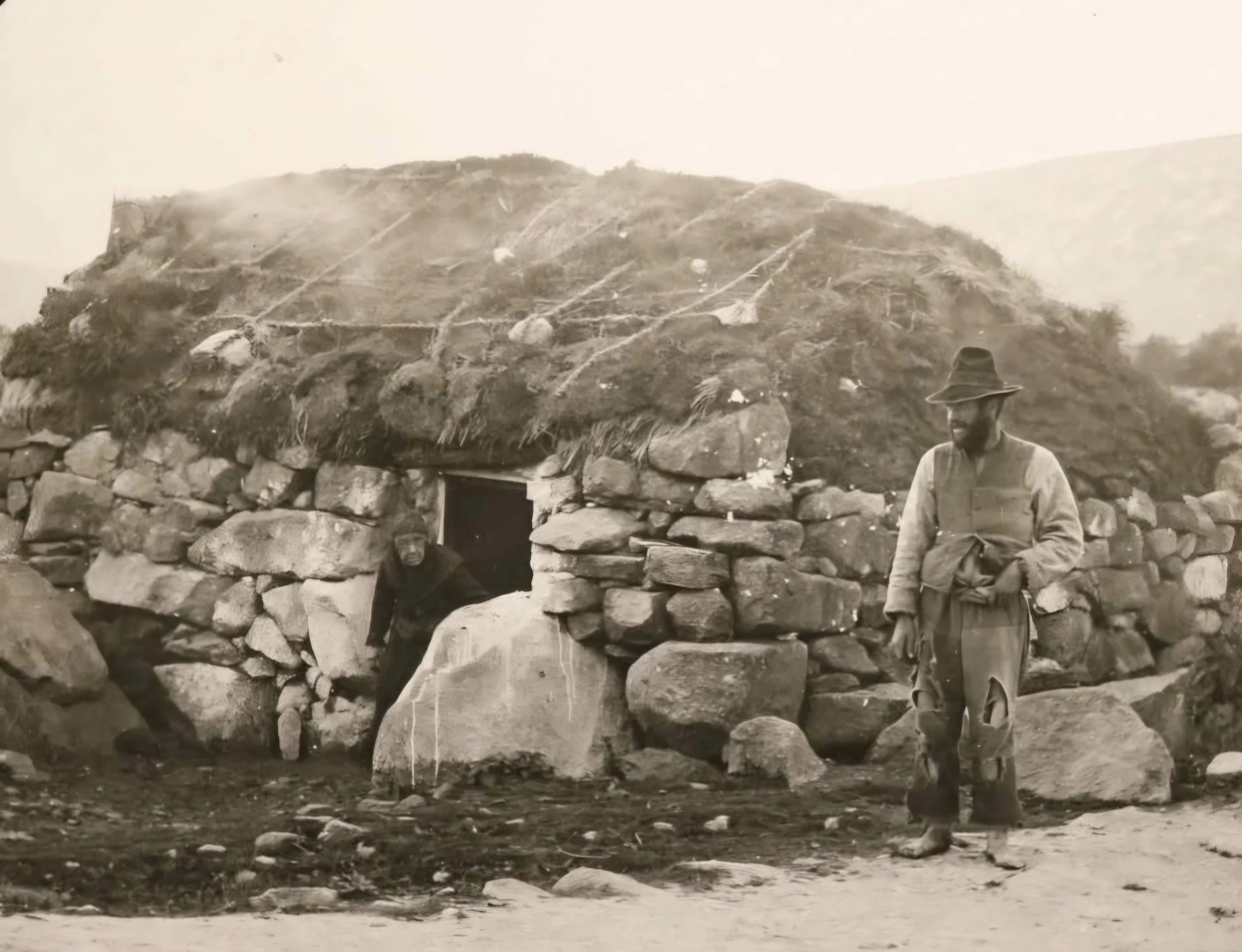
I came across this extraordinary photograph recently. It is an image that has stayed with me. Since seeing it, the woman in the photograph has even visited my dreams. You can see smoke coming from her roof, perhaps something cooking in her hearth. The photograph is remarkable in itself, but for me it has become all the more so, because of one detail in the photograph - the mountain behind her.
I know it intimately.
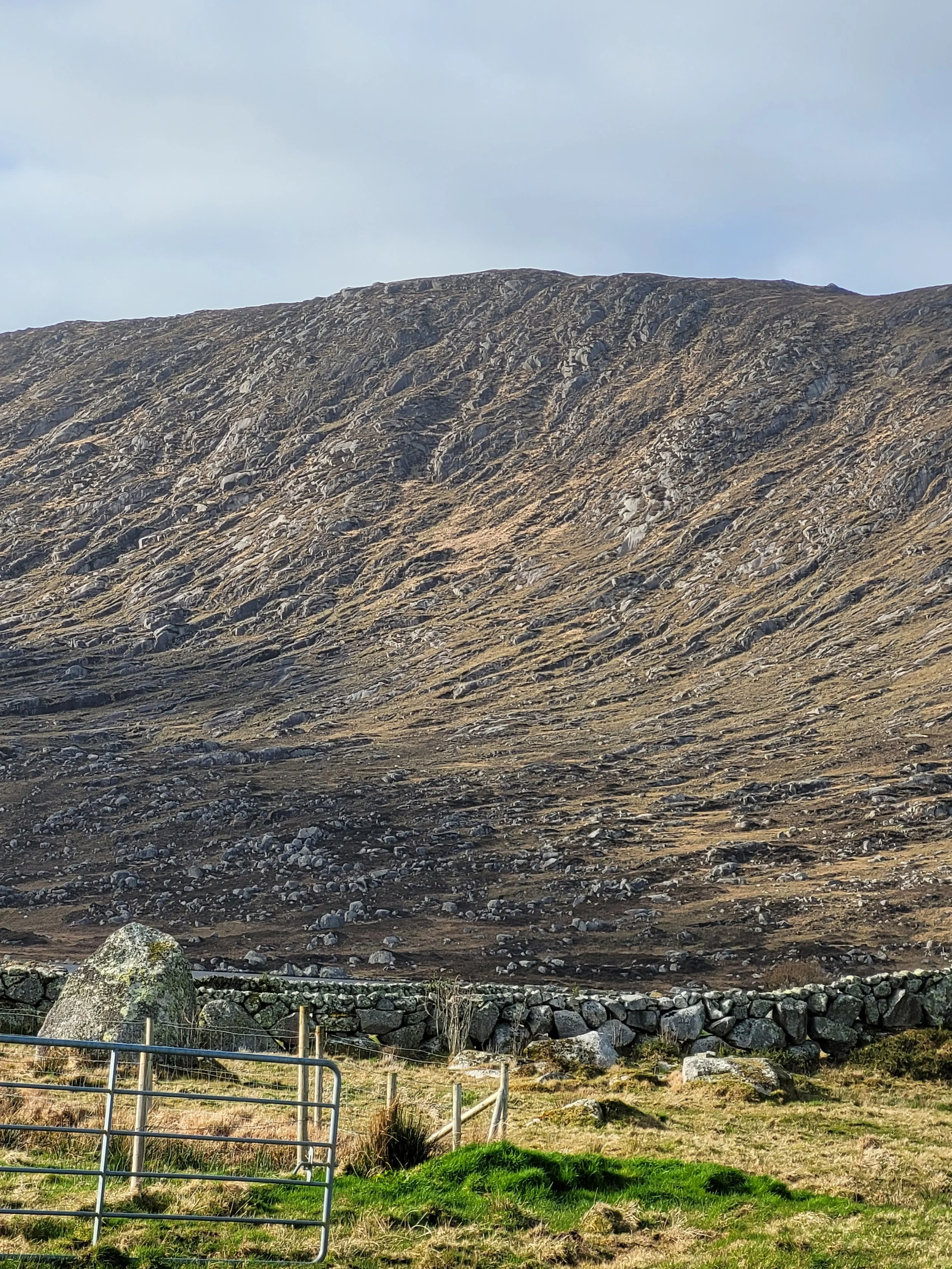
Mordáin (pronounced MORE-dawn). The mountain that I grew up beside, in my childhood.
Mordáin was one of the Tuatha Dé Danann and was known as “the King of all the Ghosts.” It is quite something to live with a mountain at your back. It enters you somehow. I know its outline without looking. I know it in different weather, in different light, in different seasons. It has its own moods. I grew up with Mordáin there. Always there. When I went out to the turf shed at night, Mordáin was there - my witness, my company. A looming presence that filled me, strangely, with awe, fear and comfort, all at once. I watched weather move the face of it. I knew its changing light, its darkness, its shape against the sky. And somewhere along the way, the outer mountain became an inner one. Mordáin entered my dreams. I have written about it so often. It lives in me.
And then I found this photograph.
Their Names Have Disappeared From Living Memory
No one in my village now seems to know who these people were. Their names have disappeared from living memory. One of my older neighbours recounts remembering the old ruin of this house as a ‘shed’ in the 1960s, when he was young.
I look at the woman in the doorway and the man standing outside and wonder who they were, what occupied their days, what they feared, what they loved, what stories they carried. But there is one thing I do know. They had the same mountain at their back. There are no windows on their dwelling, which was common enough at the time, as windows meant extra rent from the landlord, a cost they could not afford. I see the stones they put in place to build their home. I see the smoke rising out of the thatch.
They knew Mordáin in rain and darkness. Like me, they watched weather move across it. They woke beneath it and went to sleep beneath it.
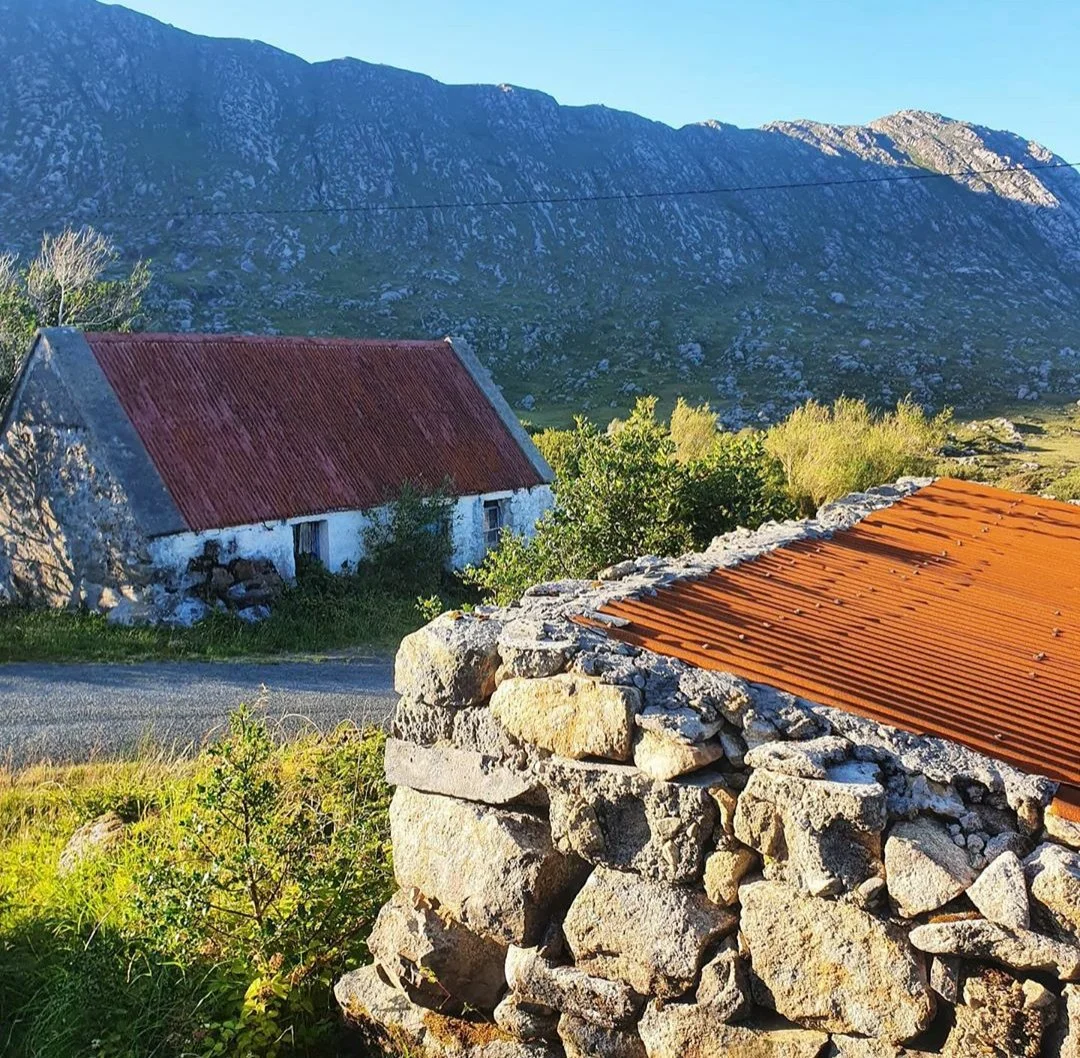
I wonder what the name Mordáin meant to them? What stories did they hear about the mountain? What images lived in them? What had been passed down through their parents and grandparents, and all who came before them? Were they my own people? If not, then, i look behind that dwelling, up towards where I know my own people lived. What were my ancestors doing the moment this photograph was taken, some 5 minutes away?
I wonder what did they know about the Cailleach or the cry of the Bean Sídhe? What stories did they have about the shapeshifting Púca encountered on the hill-side, how did they live alongside the Aos Sí (the fairies)?
“The birds have vanished into the sky and now the last cloud drains away. We sit together the mountain and me, until only the mountain remains.”

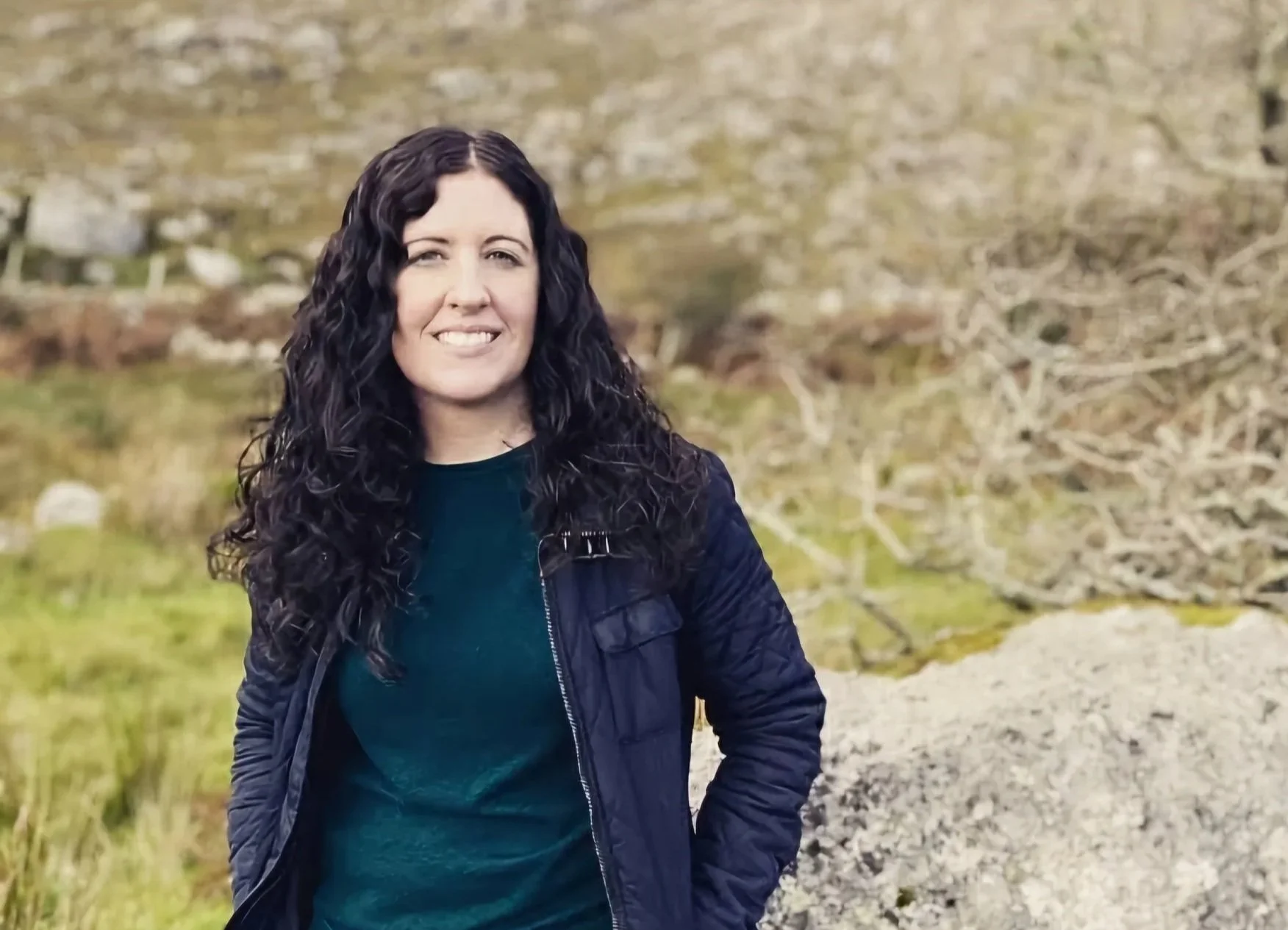
Eileen Ni Shuilleabhain (me) in her childhood village of Loch Con Aortha, Connemara, Ireland.
What Images Live in Us? - Jungian Psychology and the Inner World
Jung understood the unconscious as communicating largely through images: through dreams, fantasies, symbols, and recurring figures whose significance is not always immediately clear to us. He was interested in the way an image can appear before we consciously understand what it means, carrying associations that unfold only with time.
Have you ever experienced a coincidence that seemed to carry an unusual sense of meaning?
Perhaps you dreamed of someone you had not thought about for years, only to hear from them the following day; or a particular image, name, place, or story appeared repeatedly at a moment when it seemed strangely relevant to something unfolding in your life. Jung was interested in experiences such as these - not simply because they were improbable, but because of the meaning they seemed to hold for the person experiencing them.
The question, from a Jungian perspective, is not necessarily whether such an event can be proved to have an unseen cause, but what happens when an event in the outer world unexpectedly corresponds with something taking place within us. Why does this particular coincidence affect us? What meaning gathers around it? And what might it reveal about the relationship between our inner and outer worlds?
Jung also proposed that the psyche contains more than the personal unconscious formed through an individual's own life and experience. Beneath this, he suggested, lies what he called the collective unconscious: a deeper, shared dimension of the psyche associated with recurring patterns of human experience. He called these patterns archetypes. Importantly, Jung did not simply mean that we inherit particular memories or ready-made images from our ancestors. An archetype is better understood as an underlying tendency or pattern that may take different forms depending upon the person, culture, and historical moment in which it appears.
This raises a question I often return to in my own work: what happens when these deeper patterns of psyche meet a particular landscape, a particular culture, and a particular ancestral history?
I think here of the Cailleach, the Bean Sí, the Púca, and the Aos Sí. These are not simply Jungian “archetypes.”
They are culturally specific beings with their own histories, traditions, names, stories, and relationships to place.
To reduce them to universal psychological symbols would risk losing precisely what makes them distinctive.
The Cailleach belongs to particular landscapes and traditions;
the Bean Sí to particular histories of kinship, death, and lamentation; the Aos Sí to complex bodies of belief concerning place, boundaries, encounter, and the otherworld.
Yet neither do I think we need to regard such figures merely as dead images belonging to people in the past.
Whether we grow up in New York, Alaska, or Connemara, the places and cultures that surround us can also become part of our inner world. Landscapes, stories, family histories, and traditions give us images through which we come to imagine ourselves and the world around us.
In this sense, perhaps what is passed from one generation to another is not memory itself, but a world of images and associations. We encounter them in stories and place-names, in family traditions and local landscapes, and in the ways people before us gave form to experiences that remain fundamental to human life—birth and death, danger and loss, transformation, uncertainty, and encounters with what cannot easily be explained.
From a Jungian perspective, these inherited cultural images may sometimes intersect with deeper and more widely recurring patterns of human experience. But one need not explain the other away. The psychological significance of an image does not erase its cultural history, just as its cultural history does not exhaust everything that image may come to mean to an individual.
And sometimes an old image rises again unexpectedly: in a dream, in a story heard since childhood, in the face of someone in an old photograph, or in a mountain we have known all our lives. Rather than asking immediately whether such an image is “only” psychological, cultural, ancestral, or symbolic, perhaps we can ask a different question: what has gathered around this image over time, and why has it become alive for us now?
That question leaves room for psyche and culture, for personal memory and inherited story, and for the particular landscape in which all of them meet.

At the foot of Cnoc Mordáin (Mordàin’s Mountain), Loch Con Aortha, Connemara, Ireland
Exploring the Inner Images - Deepening the Senses
There is another Jungian idea that could take this deeper still: the distinction between a symbol and a sign. A sign can be explained—once you know what it refers to, you're more or less finished with it. A living symbol can't be exhausted like that. It continues producing meaning. That feels very close to what you are experiencing with Mordáin. The mountain isn't merely representing your childhood, your ancestors, the Otherworld, or the Cailleach. It seems to hold more than any one interpretation can contain. In 2016 i wrote a poem about the mountain. in it is the line:
I listen to an ancient
breathing
buried here beneath this creaking world.
And then, ten years later, I encounter an unknown woman in an old photograph with the same mountain at her back, and she subsequently appears in your dreams. My poem knew this before I consciously formulated it: Perhaps the question is - What happens when we allow an image to remain alive long enough to speak back to us? certain images constellates something in us —a cluster of dream, childhood, ancestry, landscape, folklore and imaginationand when we tend to what begins to gather around it, it becomes potent. the archetypal and the ancestral meet in the particular image.
In my Deepening the Senses work, we become curious about our own inner world and, particularly, about the images that arise within us. We are so accustomed to giving our attention to the world outside—to what we can see, name and explain—that we can easily overlook the imaginal life unfolding within. Yet the unconscious does not necessarily speak in explanations. It speaks in images: through dreams, memories, sudden associations, recurring figures, places we cannot forget, and images that arrive carrying an emotional charge we may not immediately understand. Depth psychology asks us not to rush to interpret these images, but to become curious about them. To stay with them. What happens if, rather than asking immediately What does this mean?, we ask: What is this image asking of me? Why this image? Why now? What gathers around it when I give it my attention?
Staying with an image—allowing it to unfold, to gather associations, to surprise us—can bring us into relationship with parts of ourselves for which consciousness has not yet found words. There is a beautiful thought in Rilke that we must, in a sense, give birth to our images; that what feels strange within us may belong not only to what has been, but to something still waiting to become.
This is part of what we practise in Deepening the Senses: developing a greater sensitivity not only to the sensory world around us, but to the inner landscape that responds to it. Outer and inner begin to speak to one another. A mountain is a mountain—and yet a particular mountain may also become part of our dream life, our memory, our sense of belonging, even our understanding of ourselves.
Perhaps this is why finding that old photograph of Mordáin affected me so deeply. I wasn't simply recognising a mountain. I was encountering an image that already lived somewhere inside me. And that opens the larger question:
What images live in us?
Which belong to our individual lives, and which come to us through family, story, language and place? Which images have been carried for generations? And what happens when the ancient images of a culture—the Cailleach on the mountain, the Bean Sí lamenting the dead, the daoine sí beneath the earth—meet the images of our own unconscious?
I wouldn't say we can neatly separate one from the other. Perhaps the more interesting practice is simply to become curious.
To notice what appears. And to listen.
Where do our images come from?
Jung's idea of the collective unconscious offers one way of staying with that question. Perhaps an image can be personal, cultural and archetypal all at once. Mordáin is the actual mountain of my childhood, intimately bound up with my own memories and dreams. It also belongs to the stories and imaginative life of the place from which I come. And beneath both of these is the far older human image of the mountain. I don't know what to make of the fact that I wrote of an ancient breathing beneath the mountain, and of ghost children among the ruins, before I knew the story of Mordáin. I don't want to explain it away. Nor do I want to make it prove something that cannot be proved. I would rather remain curious. Perhaps that is what an image asks of us. Not always to interpret it, but to enter into relationship with it.To notice when it returns. To notice what gathers around it. To allow it to lead us somewhere we could not have arrived at through the rational mind alone. The mountain was part of my outer landscape long before I understood how deeply it had entered my inner one.
The Mountain
In my dreams
I still hear the wind
scorch the mountain side
peeling granite ridges bare.
Night soothes the bruises
seeps black-slickened oil
into crevices
distilling into air.
I listen to an ancient breathing
buried here beneath this creaking world.
I light a bonfire on the hill
kindling made from ragged scars.
Flames fever at first than burst
fall to embers.
Heather and thistle.
Loneliness like a death
bristles underfoot.
Ghost children
play among ruins.
Family faces familiar, yet strange.
Women barefoot
wash clothes in streams.
In my dreams
I still see the mountain.
Published in the Burning Bush Literary Journal 2016
A Door into the Dark
Bean Sídhe | ‘Woman of the fairy mounds’ (Banshee)
Chaos at the Threshold
The Cailleach, Samhain and the Supernatural.
We journey into Samhain and the dark half of the year, encountering the Bean Sídhe of the Gaelic Otherworld and the ancient Crone of winter, the Cailleach. Drawing upon Irish folklore, ancestral tradition, and Jungian depth psychology, we explore a time when the boundaries between worlds grew uncertain and the unseen drew near—entering the wintering dark and its mysteries of chaos, uncertainty, and transformation.
We journey into Samhain and the dark half of the year, encountering the Bean Sídhe of the Gaelic Otherworld and the ancient Crone of winter, the Cailleach. Drawing upon Irish folklore, ancestral tradition, and Jungian depth psychology, we explore a time when the boundaries between worlds grew uncertain and the unseen drew near—entering the wintering dark and its mysteries of chaos, uncertainty, and transformation.